Mechanism, plainly
How Ipamorelin Works in the Research
One switch, two destinations: a clean growth-hormone pulse, and a nudge to the gut. Here's the whole thing in plain words.
In plain English
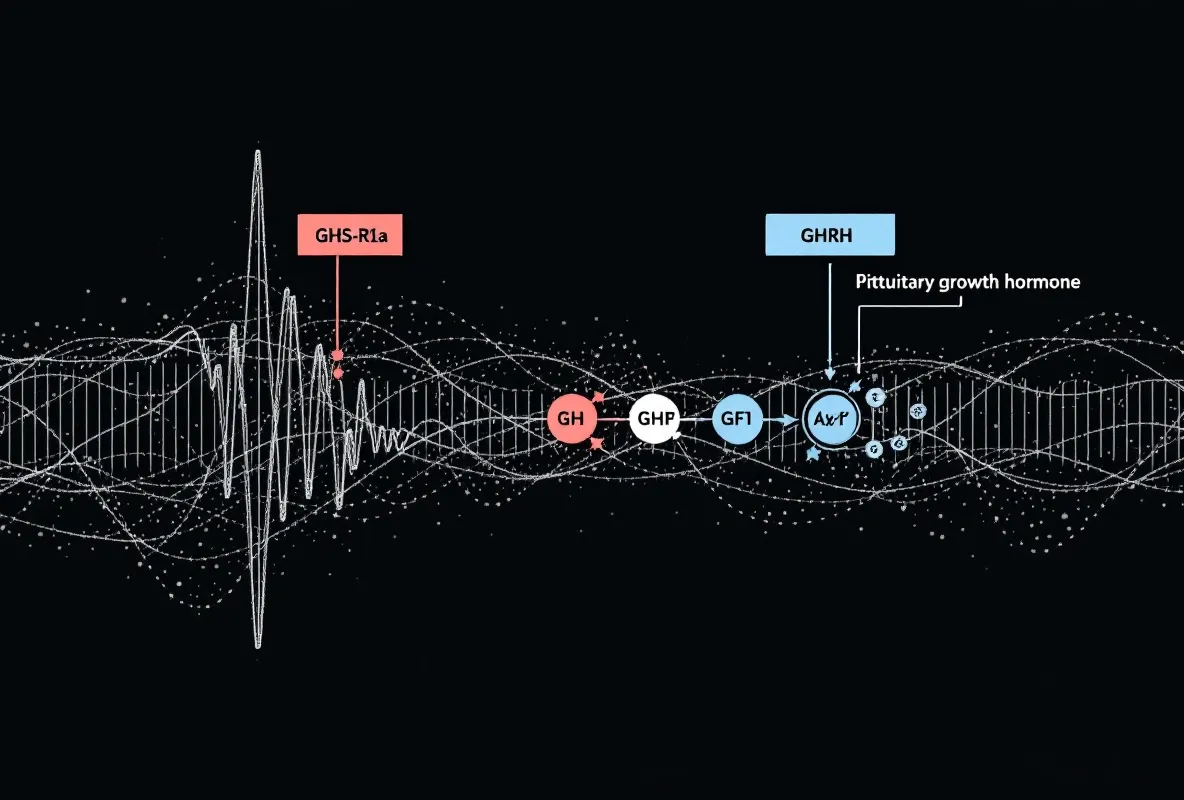
Wondering what does ipamorelin peptide do? Picture a single light switch wired to two rooms. The switch is the ghrelin receptor (GHS-R1a) — the same one your hunger hormone uses. Ipamorelin is a five-piece peptide shaped to flip that switch [1].
Flip it, and two things happen. In the brain's pituitary gland, the switch fires off a short burst of growth hormone — and here's ipamorelin's special trick: it does that cleanly, barely touching the stress hormone cortisol or prolactin, even at very high doses [1]. In the gut, the same switch sits on nerves that drive motility (the squeezing that moves food along), which is why ipamorelin was first tested to restart the bowel after surgery [9][10].
That's the whole machine: one receptor, a clean GH pulse, and a gut signal. Below, each part in a little more detail.
What is ipamorelin peptide?
What is ipamorelin peptide, concretely? It's a wholly synthetic pentapeptide — five amino acids in the sequence Aib-His-D-2-Nal-D-Phe-Lys-NH2 — engineered from an earlier peptide (GHRP-1) by snipping out a middle piece [1]. Two of its building blocks are "D-form" mirror-image amino acids, and position one is a non-natural amino acid called Aib; together they make the molecule tougher against the enzymes that would normally chew it up. It is not something your body makes — it's a designed ghrelin mimetic (a copy of the hunger hormone's action) that targets the GHS-R1a receptor [1]. Class-wise it's a growth hormone secretagogue, meaning "a thing that makes the body secrete growth hormone."
The clean pulse: why selectivity is the whole story
The reason ipamorelin got a name and a research program is one word: selectivity. Older growth-hormone-releasing peptides like GHRP-6 work, but they also bump cortisol and prolactin — unwanted spillover. Ipamorelin's founding study showed it releases GH about as strongly as GHRP-6 (in pigs, a half-maximal dose around 2.3 nmol/kg) while leaving ACTH and cortisol essentially flat, even at doses over 200 times the GH dose [1]. That "does one job and stays in its lane" profile is the defining feature; everything else about the compound is downstream of it.
Downstream, the growth-hormone pulse can feed the liver's IGF-1 signal — though, notably, short rodent studies often didn't show a rise in total IGF-1, suggesting some effects are local or pulse-driven rather than systemic [4]. The GH response itself is a clean single spike, peaking about 40 minutes after a dose in humans and clearing with a roughly two-hour half-life [2].
The gut signal: the other room
The second destination is the one this site leads with. The ghrelin receptor isn't only on the pituitary — it's on enteric and vagal nerves that control gastric motility. When ipamorelin activates those, animal studies show the stomach empties faster and the bowel wakes up: in rat models of post-surgical ileus, it accelerated gastric emptying and raised stool output and food intake [9][10]. The mechanism runs through the ghrelin receptor and cholinergic (acetylcholine-using) nerves, confirmed in cells [10]. This is the same prokinetic (gut-speeding) action seen across the whole ghrelin-agonist class [11] — ipamorelin is one member of a family being explored for gut-motility problems.
What is cjc 1295 ipamorelin?
What is cjc 1295 ipamorelin? It's the most popular pairing in this corner of peptide research — ipamorelin combined with CJC-1295. The two work through different switches: ipamorelin flips the ghrelin receptor [1], while CJC-1295 is a long-acting GHRH analog that flips the separate GHRH receptor. The idea is that hitting both doors at once produces a larger, more natural growth-hormone release than either alone. It's a mechanistically sensible combination — but, crucially, the combination itself has never been tested in a published trial for any outcome. The rationale is built from each drug's solo pharmacology, not from a study of the two together. The deep dive on the appetite side lives at does ipamorelin make you hungry.